
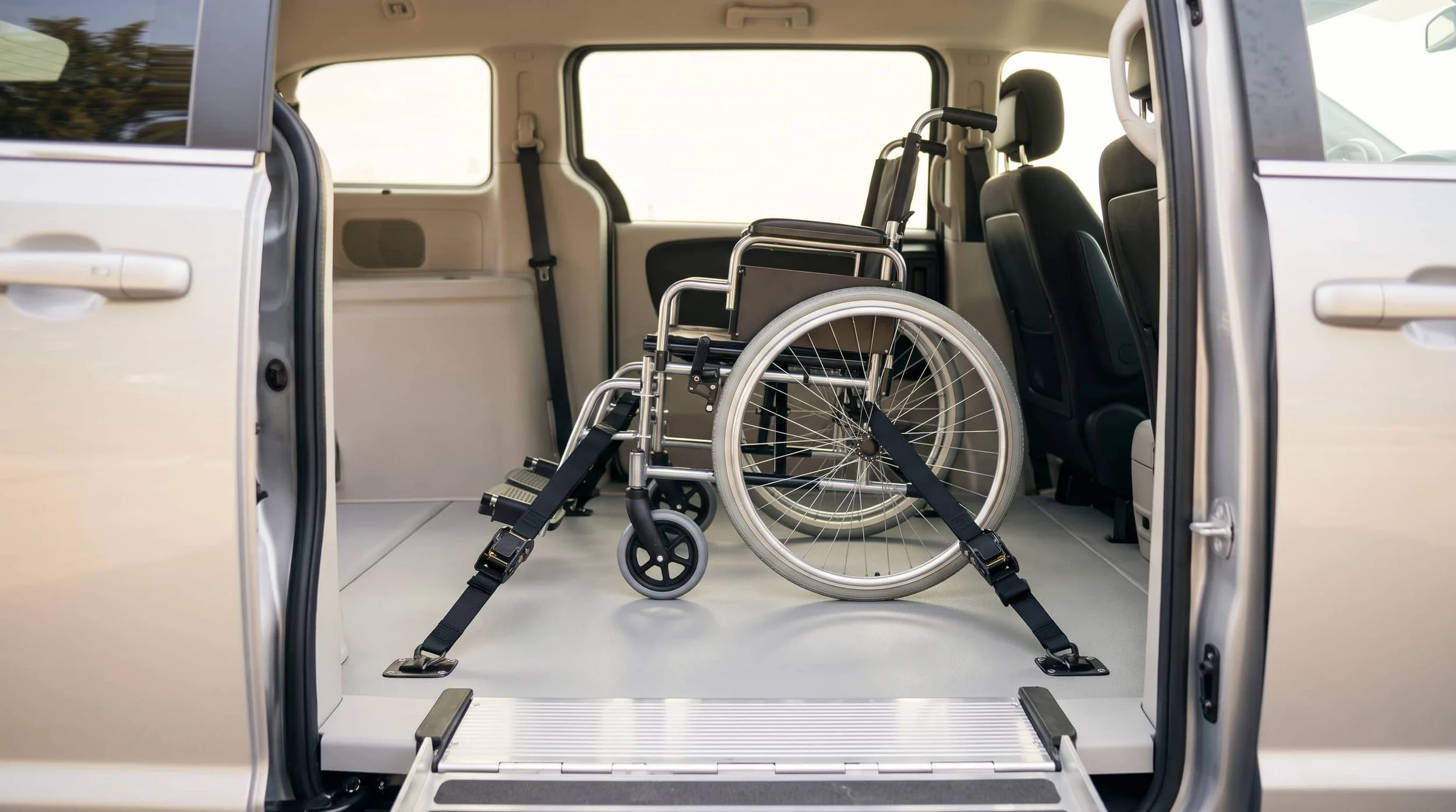
Four straps lock the wheelchair to the vehicle floor, and a separate lap and shoulder belt holds the rider. The chair should not shift more than two inches.
That two-inch figure is not a rule of thumb. Federal accessibility standards for buses and vans require a securement system to limit the movement of an occupied wheelchair to no more than 2 inches in any direction under normal vehicle operating conditions.
So the honest answer to the question families ask most is yes, the chair is held in place, and there is a measurable standard behind it. What follows is how that happens, what the straps are doing, and which questions tell you whether a driver has been trained properly.
What Does Wheelchair Securement Actually Mean?
It means two separate jobs done by two separate systems. One system holds the wheelchair to the vehicle. The other holds the person in the wheelchair. They are not interchangeable, and a trip is only secure when both are in place at the same time.
The federal standard spells that out. It requires a passenger seat belt and shoulder harness for every securement device provided, and states that those belts must not be used in place of a device that secures the wheelchair itself.
That distinction is the whole safety idea. A rider belted to a chair that can roll is still moving. A chair bolted down with an unbelted rider still leaves the body unprotected. Both parts have to be in place for the ride to be safe.
The position of the chair matters too. In vehicles longer than 22 feet at least one securement spot must face the front of the vehicle, and rear-facing positions require a padded barrier behind the rider. There are good reasons wheelchair users should face forward during transport, and the standard reflects them.
What Are the Main Types of Wheelchair Tie-Downs?
Two families of hardware do this work: strap tie-downs and docking systems. Both appear in laboratory crash research, and both are in everyday use. They suit different riders, and the one you meet depends mostly on whose vehicle you are riding in.
Four-Point Strap Tie-Downs
This is the system most people picture. Four securement points connect the wheelchair frame to anchors in the vehicle floor, and the driver tightens each one by hand or lets a retractor take up the slack. The straps go to points on the frame, never to a wheel or a footrest.
It is also the system used in published crash testing. Researchers tested WC19-compliant wheelchairs secured with 4-point tiedowns against aircraft seating standards, and the same hardware appears throughout motor-vehicle crash research, which is why it is the arrangement most safety data describes.
Strap tie-downs fit almost any chair, which is their main advantage and the reason transport providers use them. The trade-off is that someone else has to attach them correctly every single time, which puts the weight on driver training rather than on the hardware.
Docking Systems
A docking system works the other way around. Hardware mounted under the wheelchair locks into a receiver bolted to the vehicle floor, so the rider drives in and the chair latches itself. Nobody has to crouch on the floor with four straps.
Research covers this hardware too. A 2024 study in Traffic Injury Prevention built and validated computer models of manual and power wheelchairs along with 4-point strap tiedowns, traditional docking hardware and hardware built to the Universal Docking Interface Geometry, testing them in front, side and rear sled impacts.
Docking suits regular riders in their own vehicle more than it suits one-off trips, because the chair needs the matching hardware fitted underneath to work at all. For someone who travels daily, the independence is the point, and the time saved at every pickup adds up.
Tie-Downs and Docking, Side by Side
The table below sets the two systems against each other on the points that matter to a rider, with a short note on what the research has actually measured. Neither system is the right answer for everyone, and the comparison is meant to show why.
| What to compare | Four-point strap tie-downs | Docking system |
|---|---|---|
| How the chair is held | Four securement points run from the wheelchair frame to anchors in the vehicle floor | Hardware under the chair locks into a receiver fixed to the vehicle floor |
| Who attaches it | The driver, before every trip | The rider, by driving into the dock |
| Crash research | Used in published crash testing of WC19 wheelchairs and in sled tests of manual and power chairs | Modeled and sled-tested in front, side and rear impacts, including Universal Docking Interface Geometry hardware |
| What riders report | Workable, but rated lower for comfort and sense of security in one 2023 study | Rated better for usability, less discomfort and greater security by 15 powered wheelchair users |
| Fits which chairs | Almost any chair | Only chairs fitted with matching docking hardware |
Are the Straps Enough if There Is a Crash?
The hardware is built and tested for crash forces, not just for sharp braking. Federal standards set the load each securement leg has to take, and the research puts the whole arrangement through impacts at highway speeds rather than estimating what might happen.
On vehicles with a gross weight rating up to 30,000 pounds, which covers vans and minivans, the standard requires the securement system and its attachments to restrain a forward force of up to 2,500 pounds per securement leg, and at least 5,000 pounds for each mobility aid. Those numbers describe a crash, not a pothole.
The crash-test work points the same way. A 2026 study in the SAE International Journal of Transportation Safety reports that many wheelchairs meet voluntary crashworthiness standards under RESNA WC19 for motor vehicle travel, and tested those chairs with 4-point tiedowns against aircraft seating requirements.
What matters in practice is correct use rather than stronger hardware. Straps have to go to the manufacturer's securement points, be tightened, and be paired with the rider's own belt. A system installed to the standard and used properly is doing what it was designed to do.
None of this makes a transport van the right vehicle for a medical emergency. If someone needs monitoring or treatment on the way, that is an ambulance rather than a non-emergency ride, and the choice should be made before the trip is booked.
What Is a WC19 Wheelchair, and Does It Matter?
WC19 is a voluntary safety standard that defines crashworthiness requirements for wheelchairs used as seats in ground vehicles. A chair built to it has been crash tested and has marked securement points the straps are meant to attach to.
The standard exists because of a gap the Americans with Disabilities Act did not close. A 2026 paper in Assistive Technology explains that the ADA drove accessibility into vehicles, while RESNA WC19 was created separately to define how the wheelchair itself must perform in a crash.
For a rider, the practical value is simple. Marked securement points remove the guesswork for whoever is attaching the straps, and the chair has been tested with forces in the same range the vehicle hardware is rated for.
If you do not know whether a chair is WC19-compliant, the supplier or the manufacturer's literature will say. It is a reasonable thing to check before buying a chair that will spend years riding in vehicles, and it is easier to ask now than after delivery.
Can a Heavy Power Wheelchair Be Transported the Same Way?
Yes, with the same families of hardware, though weight is a real variable and docking systems were designed partly with power chairs in mind. A power chair can weigh several times what a folding manual chair weighs, and that changes the forces on every strap.
The research on power chairs is specific. The 2024 Traffic Injury Prevention study modeled a commercial power wheelchair alongside a manual one and ran sled tests in front, side and rear directions with different securement methods, which is how engineers check that heavier chairs behave predictably.
Comfort data exists as well. A 2023 study in Vibration compared a low-profile automatic docking system against a 4-point tiedown system with 15 powered wheelchair users on real-world road surfaces. Both kept shock exposure below health-risk margins, and participants rated the docking system better for usability, comfort and sense of security.
For a one-off trip in a provider's van, strap tie-downs are what you will meet, and they handle power chairs routinely. Tell the dispatcher the chair is a power chair and roughly what it weighs, because that affects which vehicle and which lift are sent.
Can You Use a Regular Car or a Rideshare Instead?
Not if the person stays in the wheelchair. A sedan has no floor anchors, no securement system and no lift, so there is nothing to attach the chair to and no way to lift it in. The chair would sit loose on a seat or in a trunk.
Plenty of people try anyway, which is why the question comes up. The 2026 Assistive Technology survey of 69 wheelchair users found personal vehicles used by 75.4% of respondents and taxi or rideshare services by 33.3%, both more common than public transportation, and no routinely used public transportation met users' needs more than a quarter of the time.
A rideshare can work when the rider transfers into a regular seat and the chair folds into the trunk. That is a different trip from riding seated in the chair, and the difference between a regular car and a wheelchair accessible vehicle is worth understanding before anyone is standing at the curb.
Accessible vehicles are built around the securement area. The standard requires a clear floor space of 30 by 48 inches for it, plus a lift or ramp rated for at least 600 pounds of design load. A car cannot be adapted into that with a strap from a hardware store.
What Should You Ask a Transport Provider Before the Trip?
Ask about the hardware and the training, not just the price. A short list of questions separates a properly equipped operator from a van with a ramp, and none of them require any technical knowledge to ask or to judge the answers.
How is the wheelchair secured, and does the vehicle use strap tie-downs or a docking system?
Will the rider get a lap and shoulder belt that is separate from the wheelchair's own postural straps?
Will the chair face forward during the trip?
Can the vehicle and lift handle a heavy power wheelchair, and what is the weight limit?
Who attaches the securement, and how are the drivers trained for it?
How much help is included at each end of the trip?
That last question is the one families forget. The level of help ranges from a ride that stops at the curb to a driver who comes inside the building, and knowing the difference between curb to curb, door to door and door through door prevents an unpleasant surprise on arrival.
If any of these answers are vague, ask again. A provider that secures chairs every day will answer each one without hesitating, and MediZoom Transportation covers the same ground when a trip is booked. If you want the mechanics first, how wheelchair transportation works walks through a standard trip from pickup to drop-off.
Frequently Asked Questions
How much floor space does a securement area need?
The federal standard requires a clear floor area of 30 inches by 48 inches for the securement system, placed as near the accessible entrance as practicable. That space can overlap an access path and may have fold-down seats, as long as the folded seats do not block it.
How many securement positions does an accessible vehicle have?
It depends on vehicle length. Vehicles longer than 22 feet must have at least two securement locations and devices, while vehicles 22 feet or shorter must have at least one. That is why a larger shuttle can carry two wheelchair riders and a minivan usually carries one.
How much weight does a vehicle lift have to handle?
The design load of the lift must be at least 600 pounds. Working parts that wear, such as cables, pulleys and shafts, need a safety factor of at least six based on the ultimate strength of the material, which is why lifts are inspected rather than simply trusted.
Can someone stay in their wheelchair on an airplane?
Not under current rules. The 2026 SAE study notes that commercial air travel rules do not allow passengers to sit in their own wheelchairs during flight, and its testing of WC19 chairs with 4-point tiedowns was done to find out whether that could change safely.
Do most wheelchair users know about the WC19 standard?
Only about half. In the 2026 Assistive Technology survey, 56.5% of participants had prior knowledge of WC19, 62.5% used a WC19 wheelchair, and 68% said they were more interested in getting one after answering the questions.
Does the wheelchair's own postural belt count as a seat belt?
No. The standard treats the two as separate, requiring a passenger seat belt and shoulder harness for each securement device and stating that those belts cannot replace the device that secures the wheelchair. Postural straps keep a rider positioned; they are not crash restraints.
Sources Used
Text of the Guidelines – U. S. Access Board
Crashworthiness of WC19 Wheelchairs in Horizontal Dynamic Aircraft Seating Tests – SAE International Journal of Transportation Safety, via PubMed (2026)
Development and validation of a set of wheelchair finite element models in frontal, side, and rear impact conditions – Traffic Injury Prevention, via PubMed (2024)
Usability and Vibration Analysis of a Low-Profile Automatic Powered Wheelchair to Motor Vehicle Docking System – Vibration, via PubMed (2023)
Wheelchair transportation: User perception of safety, availability, and WC19 knowledge – Assistive Technology, via PubMed (2026)
Vehicle Accessibility – National RTAP (2026)
Disability Law Index – Transportation: Securement Devices
