
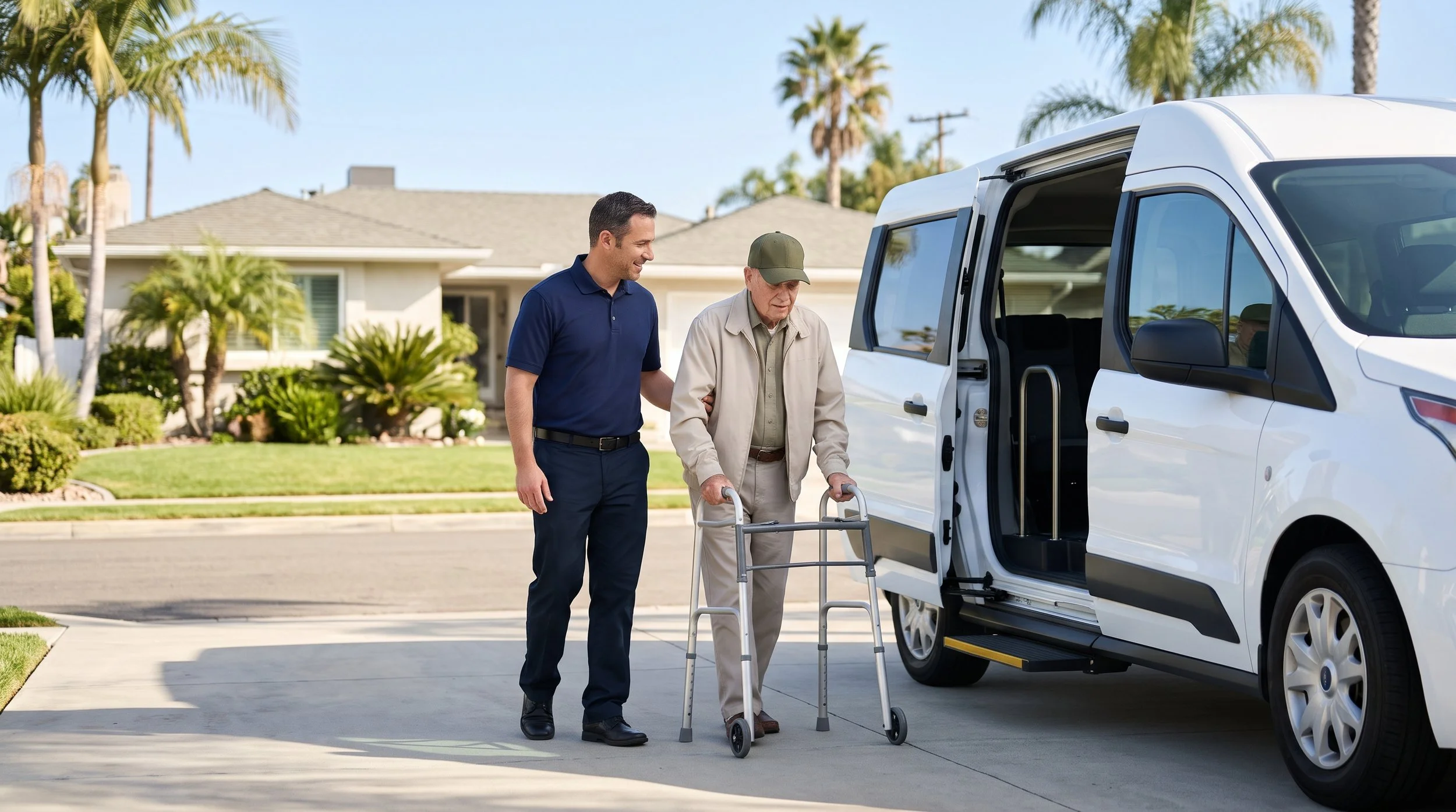
VA transportation comes in four routes: free VA-run rides, volunteer veteran vans, mileage pay for driving yourself, and private medical transport you book directly.
The VA-run option is called the Veterans Transportation Service. The Veterans Transportation Program states that veterans eligible for VA health care benefits who have a VA-authorized appointment can receive transportation through VTS, depending on local availability (Veterans Transportation Program (VTP)).
The program was built for veterans who are visually impaired, elderly, or immobilized by disability, which is wider than most people assume. A cane, a walker, low vision, or simply no safe way to drive all fit inside that description. Nothing requires a wheelchair.
Who Can Get a Free Ride From the VA?
Enrolled veterans with a VA-authorized appointment, where the local facility runs the service. VTS is not offered at every VA medical center, so availability at your own facility is the first thing to check. Eligibility for VA health care and an authorized appointment are the two fixed requirements.
What the Service Covers
VTS rides go to VA medical visits and to authorized non-VA appointments in the community. The network works with veterans service organizations, community transportation providers, and government transportation agencies, so the vehicle that arrives may belong to a partner rather than to the VA itself.
Where to Start the Request
Every participating facility has a Veterans Transportation Program representative, and that person is the right first call. The VA keeps a state-by-state contact list, and the same representative can help with a travel pay claim (Veterans Transportation Program representatives). Ask two questions: does this facility run VTS, and how far ahead do rides need to be booked.
How Does VA Travel Pay Work If You Drive Yourself?
The VA pays a set rate per mile, minus a small monthly deductible. The current rate is 41.5 cents per mile for approved health-related travel, and mileage is measured door to door from your home to the closest VA or authorized facility that can provide the care you need (Reimbursed VA travel expenses and mileage rate).
Who Qualifies for Travel Pay
Eligibility is a checklist, not a judgment call. You have to be traveling for care at a VA facility or for VA-approved community care, and at least one of these has to be true: a VA disability rating of 30% or higher, travel for a service-connected condition, a VA pension, income below the maximum annual VA pension rate, inability to afford the travel, or travel for a claim exam, a service dog, or approved transplant care (File and manage travel reimbursement claims).
The Deductible and the Filing Window
Two details catch people out. A deductible of $3 one way or $6 round trip applies to each appointment, up to $18 in a month, after which approved travel is paid in full for the rest of that month. Claims should be filed within 30 days, because later claims are usually denied.
Mileage, parking, and tolls need no preapproval. Buses, taxis, rideshare, trains, planes, and special-mode vehicles do, and so do meals and lodging. Travel pay also needs its own direct deposit setup, separate from the one used for other VA benefits.
Are DAV Vans an Option, and How Do You Find One?
In many areas, yes. DAV operates a fleet of vehicles that provides free transportation to and from VA medical facilities for injured and ill veterans, with volunteer drivers at more than 247 VA locations nationwide (Medical Transportation).
The way in is the Hospital Service Coordinator for your nearest VA medical center. DAV keeps a directory of those coordinators, and the coordinator knows the local van schedule, the pickup points, and whether the route reaches your town. Because drivers are volunteers, coverage does not reach every community.
That volunteer model shapes what the service can promise. Vans usually run on fixed routes and fixed hours, several riders share a trip, and the return leg waits until everyone is finished. For a routine primary care visit this works well. For dialysis three days a week, or a discharge at an unpredictable hour, it often does not.
Do You Have to Be in a Wheelchair to Get Help?
No, and the opposite problem is more common. Ambulatory veterans assume the programs are not for them and never ask, while the wheelchair and stretcher services actually carry the strictest rules of all.
Special modes of transportation, including stretcher, wheelchair van, and ambulance-level service, can only be authorized by the VA and require documentation of medical necessity from a VA provider. Everyday rides have no such requirement. If you are unsure which level of service a trip actually calls for, the difference between a medical ride and an ambulance is worth reading first (NEMT vs. an Ambulance: Which One Do You Actually Need?).
There is also a middle ground people miss. Walking short distances is not the same as managing a long hallway, an elevator, and a check-in desk alone, and the level of help a ride includes varies a great deal between services.
What If Driving Is No Longer Safe Because of Vision or Memory?
Then the ride has to be arranged by someone other than the veteran, and that shift is usually what makes families call. Low vision, slowed reactions, and early memory changes all end driving before anyone formally says so.
The practical questions are the same ones that come up whenever a parent stops driving: who books the trip, who confirms it the day before, and who knows the appointment schedule for the next six months. A separate post works through that handover in detail (Transportation for Medical Appointments When a Parent Stops Driving).
One detail helps here. VA travel pay covers mileage for the trip, not the driver, so a daughter or neighbor can drive and the veteran can still claim the mileage. A travel pay claim is filed per appointment, so a repeating schedule means a repeating task for whoever handles the paperwork.
Who Actually Pays for Which Ride?
The payer depends on who authorized the trip, not on who provides the vehicle. VA programs cover VA and VA-authorized care. Health plans follow their own rules, and private transport is paid directly by the rider unless a plan or program says otherwise.
Medicare is the most common source of confusion, because it covers ambulance transport in defined situations rather than routine rides to appointments. The details of that gap are laid out separately (Does Medicare Cover Non-Emergency Medical Transportation?). Medicaid, which is Medi-Cal in California, handles non-emergency rides on different terms again.
The table below sets these options side by side, so you can see which one matches the trip in front of you before making any calls. Local availability changes the picture, so treat it as a starting map rather than a guarantee.
| Option | Who it is for | How to arrange it |
|---|---|---|
| Veterans Transportation Service (VTS) | Veterans eligible for VA health care with a VA-authorized appointment, where the local facility offers it | Contact the Veterans Transportation Program representative for your state |
| DAV volunteer vans | Injured and ill veterans within reach of a participating VA location | Call the DAV Hospital Service Coordinator for your nearest VA medical center |
| Travel pay for driving yourself | Veterans who meet the VA eligibility rules, such as a 30% or higher disability rating | File online within 30 days of the appointment, after setting up travel pay direct deposit |
| Special mode transport (stretcher, wheelchair van, ambulance level) | Veterans with documented medical necessity from a VA provider | VA authorization is required before the trip takes place |
| Private medical transport | Anyone who needs a fixed pickup time, a non-VA appointment, or door-through-door help | Book directly with the transport company |
What If the Ride Has to Be Reliable?
Then a shared-route service is the wrong tool, and that is worth saying plainly. Free programs run on volunteer availability and fixed schedules, which is fine for a routine visit and hard on treatment that cannot move.
Three trip types usually need a set time rather than a route: dialysis and infusion, a surgical check-in with a reporting time, and a hospital discharge that happens whenever the paperwork clears. For those, a booked pickup is the difference between making the appointment and rescheduling it.
The level of help matters as much as the timing. Being left at a curb is not the same as being walked through a lobby and into a waiting room, and that gap shows up on the day someone is weak after treatment. Match the service to the person on that day rather than to the diagnosis.
In Ventura County, MediZoom Transportation covers gurney, wheelchair, and ambulatory rides, including VA trips, hospital admissions and discharges, and long-distance transfers, with one companion riding free. The levels of assistance are explained in Curb to Curb, Door to Door, and Door Through Door. When a trip needs a confirmed pickup time, you can request a ride with the appointment details.
Frequently Asked Questions
Can a caregiver's travel be reimbursed too?
In some cases, yes. The VA may pay transportation, lodging, and meals for a family caregiver under the National Caregiver Program, a medically required attendant traveling with you, or a transplant donor or support person. Ask before the trip rather than after.
What paperwork does a community care appointment need?
Proof of attendance. That can be a work or school release note from the community provider, or a document on the provider's letterhead showing the date the appointment was completed. Request it at checkout, because chasing it later is much harder.
Does the VA pay mileage to any facility you choose?
No. Reimbursement is calculated to the closest VA facility that can provide the care you need. If your VA provider decides you need to travel to a different VA facility, the cost of that longer trip is covered instead.
Is there help for veterans in very rural areas with no VA nearby?
There is a separate grant program for that. The VA funds veterans service organizations and state agencies to run transportation in highly rural counties, defined as fewer than seven people per square mile, and rides are free to veterans in the areas served.
Can a taxi or rideshare fare be claimed?
Only with preapproval. Bus, taxi, rideshare, subway, light rail, train, and plane fares all require approval from your local VA health facility in advance, and the most cost-effective option is the one that gets approved.
What happens if a claim is filed late?
It is usually denied. The 30-day window applies per appointment, and a new claim is needed for each one, so a monthly habit of filing works better than a quarterly catch-up.
Sources Used
File and manage travel reimbursement claims – U.S. Department of Veterans Affairs (2026)
Medical Transportation – DAV (Disabled American Veterans)
Reimbursed VA travel expenses and mileage rate – U.S. Department of Veterans Affairs (2026)
Veterans Transportation Program (VTP) – Veterans Health Administration (2026)
Veterans Transportation Program representatives – U.S. Department of Veterans Affairs (2026)
