
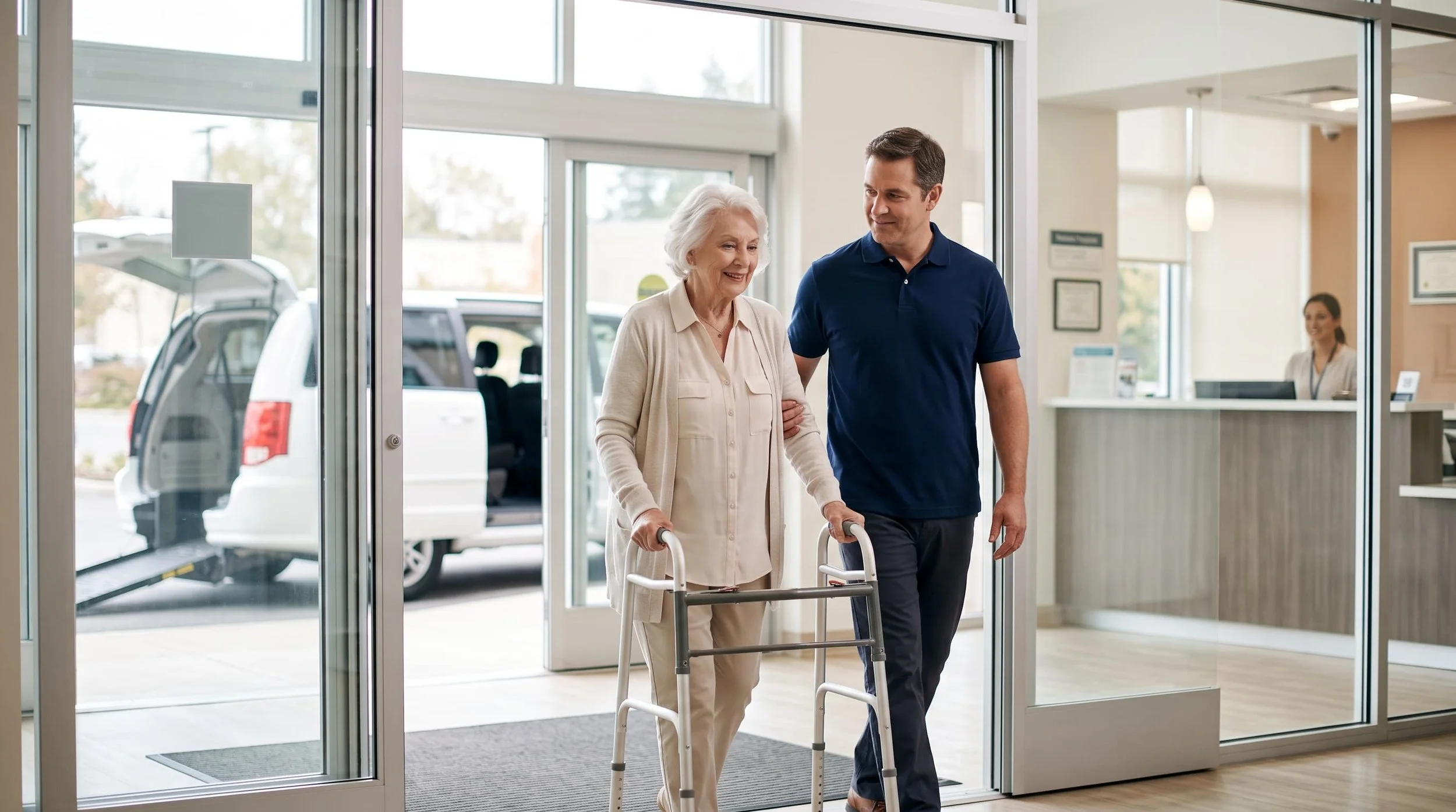
Curb to curb means the driver stops at the sidewalk. Door to door adds help to the entrance. Door through door goes inside with the rider.
The three names sound almost the same, and the difference decides whether a person reaches the exam room or stands alone on a sidewalk. Gold Coast Transit District states that its paratransit drivers are not permitted to enter buildings or private residences and must keep visual contact with the vehicle at all times.
So the level of service is not a comfort upgrade. It is the line between a ride that works for someone with dementia and one that does not. Below is what each level includes, who it fits, and the questions worth asking before a trip is confirmed.
What Does Curb to Curb Service Actually Include?
The driver picks you up and drops you off at the curb or driveway, and that is where the service ends. Most public paratransit works this way by default, because it keeps vehicles moving and keeps schedules predictable for everyone sharing the route. It is the cheapest and most widely available level, and for a lot of riders it is all they need.
You should expect help getting on and off the vehicle. Gold Coast Transit District says its drivers assist with safe boarding and exiting and secure mobility devices as required. What drivers do not do is operate a personal mobility device or provide personal or medical care.
Curb to curb works when the rider can manage the walk from the sidewalk to the front desk alone. It stops working the moment that walk involves a locked lobby door, a long corridor, or a person who gets disoriented without a familiar face beside them.
What Changes With Door to Door Service?
The driver leaves the vehicle and helps the rider between the door of the building and the vehicle. That short stretch is where most falls and most missed appointments happen, so the upgrade matters more than it sounds.
On public paratransit this is usually an accommodation rather than the standard. Gold Coast Transit District notes that door-to-door service may be provided as a reasonable accommodation when a rider's disability requires it, and that drivers must still maintain visual contact with the vehicle.
That last condition is the practical limit. A driver who cannot lose sight of the bus cannot walk a rider through a medical building. Door to door gets someone to the entrance safely, and no further than that.
What Is Door Through Door Service?
The driver goes through the doorway with the rider, into the home or the clinic, and stays until the person is with someone. This is the only level that covers the gap between the entrance and the appointment.
It matters most on the return trip. A rider coming home after a procedure may be unsteady, drowsy, or confused, and leaving them at their own front door is not the same as seeing them inside and seated. MediZoom Transportation offers door-through-door help for riders who need that handoff rather than a drop-off.
Private non-emergency medical transportation can provide this because its drivers are not bound by fixed-route scheduling. The trade-off is that it is a paid service rather than a subsidized public fare, which is why it helps to know which rides actually need it.
Which Level of Service Does Your Rider Need?
Match the level to the hardest part of the trip rather than the easiest. A rider who walks well at home may still face a long drop-off lane, a heavy glass door, and a corridor with no chairs. The table below pairs each level with what it covers and the kind of rider it usually fits.
| Service level | What it covers and who it usually fits |
|---|---|
| Curb to curb | The vehicle stops at the curb or driveway. The driver helps with boarding and secures mobility devices, then stays with the vehicle. Fits a rider who walks on their own, knows the building, and can wait safely outside. |
| Door to door | The driver walks the rider between the building door and the vehicle, while keeping the vehicle in sight. Fits a rider who uses a cane, walker, or wheelchair and needs a steady arm over uneven ground, steps, or a long drop-off lane. |
| Door through door | The driver goes inside with the rider and stays until someone takes over. Fits a rider with dementia or memory loss, anyone recovering from sedation, and anyone who cannot safely be left alone. |
If you are unsure, picture the rider arriving ten minutes early at an unfamiliar building in the rain, with no one waiting outside. Whatever help that picture needs is the level to book. Families almost never regret booking one level up; they regularly regret booking one level down.
Riders Who Walk On Their Own
Curb to curb is usually enough, and it is the least expensive option. Confirm the drop-off point in advance, because large medical campuses often have a main entrance that is nowhere near the clinic named on the appointment letter.
One detail worth checking is the wait on the return trip. A rider who can walk out to the curb comfortably in good weather may not want to do it after a two-hour infusion, so booking a different level for the ride home is reasonable.
Riders Using a Wheelchair or Walker
Door to door is the sensible default here, because the risk sits in the transfer and the walkway rather than the drive. The National Institute on Aging (2023) notes that you can request a vehicle that accommodates a wheelchair, walker, or electric scooter.
Say what the mobility device is when you book, not when the vehicle arrives. A manual chair, a heavy power chair, and a scooter need different ramps, lifts, and securement points, and matching the equipment to the person in advance avoids a cancelled trip.
Riders With Dementia or Memory Loss
Door through door is the only level that fits, and the reason is stated plainly in the rules for public paratransit. Gold Coast Transit District says its drivers do not escort passengers inside buildings or remain with passengers who cannot be left unattended.
If public paratransit is the only option available, bring an escort. A personal care assistant designated by an ADA-certified rider rides at no charge, and a companion can ride for the regular fare when space allows, which makes the escort route workable.
How Does ADA Paratransit Handle Curb to Curb in Ventura County?
ADA paratransit is public transit, so it follows federal rules and a local eligibility process rather than a rider's preference. The Federal Transit Administration (2025) keeps the ADA guidance transit agencies follow in one place, including Department of Transportation guidance on origin-to-destination service in ADA paratransit.
Locally, GO ACCESS is the Gold Coast Transit District service, described as origin-to-destination public transit for people whose disability prevents them from using the fixed-route bus, as well as seniors aged 65 and older. It serves Ojai, Oxnard, Port Hueneme, Ventura, and the unincorporated areas between those cities.
Who Qualifies, and What It Costs
Eligibility runs along two tracks. ADA certification is administered by the Ventura County Transportation Commission on behalf of GCTD and other county operators, which means an application and a determination. Riders aged 65 and older qualify with no ADA paperwork at all, which is the faster route for most families calling about a parent.
Fares are low by design. GCTD lists a one-way cash fare of $4.00 for an ADA-certified rider or a senior 65 and older, with a Premium Direct Connect trip at $8.00. The cost of a public fare is the reason it is worth sorting out which trips genuinely need a private ride.
Does Medicaid or Medicare Pay for These Rides?
Medicaid has a dedicated transportation benefit for medical trips, while Medicare coverage for routine non-emergency rides is far more limited. The two get mixed up constantly when a family starts calling around, and the difference decides whether a ride is covered or paid for at the door.
The Centers for Medicare & Medicaid Services (2025) describes non-emergency medical transportation as an important benefit for people who need assistance getting to and from medical appointments, with published guidance on accepted types of transportation and on driver and vehicle criteria.
Where the Rules Differ by State
What varies is the paperwork. States run the benefit differently, so the brokerage you call, the notice required, and the trip types approved depend on where the rider lives. Start with the number on the back of the plan card and ask who arranges rides.
Our piece on whether Medicare covers non-emergency medical transportation goes through what each program typically pays for, and where private payment usually fills the gap. Reading it before you call saves a round of hold music, because you will know which question to ask first.
How Do You Book the Right Level of Service?
Say the level out loud when you book, because assuming is where trips go wrong. Dispatchers schedule from what is written in the notes, and a note that says only the wheelchair tells a driver nothing about what happens at the door.
Give four things: the mobility device, whether the rider can be left alone, who will meet them at the destination, and what the return trip looks like. Those four details decide the vehicle, the driver, and the time allowed for the stop.
How Far Ahead to Book
Book earlier than feels necessary for public paratransit. GCTD allows reservations up to three days in advance and notes that same-day trips depend on availability and are not guaranteed, so a Monday appointment is a Friday phone call.
The background piece on how non-emergency medical transportation works covers trip types and vehicle options in more detail. How wheelchair transportation works covers boarding and securement, which is the part most families have never had to think about before the first ride.
Why Do Shared Paratransit Rides Take So Long?
Because shared service is built around a route, not around one rider. GO ACCESS is described as a mini-bus service where you will often share the ride, with the driver picking up and dropping off other passengers along the way.
That design keeps fares low and it costs time. A twenty-minute drive can become an hour, and the pickup window for the return trip may be wider than a family expects, which is hard on a rider who is tired, in pain, or cold.
Which Trips Suit a Shared Ride
The practical fix is to sort trips by tolerance rather than by cost alone. Routine, flexible trips suit shared public service. Dialysis, chemotherapy, early-morning procedures, and hospital discharges usually do not, because the timing is fixed and the rider has nothing left to give.
The National Institute on Aging (2023) also points out that transportation services come from state and local agencies, nonprofits, and companies, and that public transit agencies often have discounted fares for older adults and people with disabilities. Using more than one source for different trips is normal rather than a sign of poor planning.
What to Ask Before You Confirm the Ride
A two-minute call prevents most of the problems families describe afterward, and the questions are always the same ones. Ask these out loud and write the answers next to the appointment, so whoever is home when the vehicle arrives has them too:
● Which level of service is on this booking: curb, door, or through the door
● Where exactly will the vehicle stop, by entrance name or street
● Will the driver wait until someone meets the rider at the destination
● What is the pickup window for the return trip, and who do we call if it slips
● Can an escort ride along, and is there a charge for them
● What mobility equipment is being sent, and does it fit the rider's chair
● Who do we tell if the rider cannot be left alone at either end
Planning the visit itself deserves the same ten minutes. MedlinePlus (2026) suggests talking through which issues will come up at the appointment and who will raise them, and asking the rider whether you can have access to the provider's online patient portal.
When a trip has a hard start time or a rider who should not be left on a sidewalk, booking the level of help in advance is the whole job. Request A Ride and say what happens at the door, and the rest follows from that.
Frequently Asked Questions
Can I switch service levels between the outbound and return trip?
Usually yes, and it is often the smart choice. Many riders walk out fine in the morning and need an arm after a procedure, so booking curb to curb one way and door through door home is a normal request.
Does a wheelchair rider automatically get door to door service?
Not automatically. On public paratransit it is typically provided as an accommodation when the disability requires it, so it has to be noted on the booking rather than assumed because of the chair.
Is door through door the same as having a caregiver come along?
No. Door through door means the driver walks the rider inside and hands them off, then leaves. A caregiver stays for the appointment, which is a separate arrangement to make.
Who is responsible if a rider wanders off after being dropped at the curb?
This is exactly why the level of service is written on the booking. A curb drop-off ends the driver's responsibility at the curb, so anyone who cannot be left alone needs a level that includes a handoff.
What happens if the appointment runs much longer than planned?
Call the dispatcher as soon as you know, rather than at the original pickup time. Shared services rebuild the route around the delay, and a late call often means a much longer wait than a timely one.
Do stairs at the home change which service is possible?
They can. Steps, a steep driveway, or a narrow path affect whether a ramp or lift can be used safely, so describe the entrance when you book so the right vehicle and the right number of hands are sent.
Sources Used
ADA Guidance – Federal Transit Administration (2025)
Caregiving - taking your loved one to the doctor – MedlinePlus (2026)
GO ACCESS PARATRANSIT – Gold Coast Transit District
Non-Emergency Medical Transportation – Centers for Medicare & Medicaid Services (2025)
Services for Older Adults Living at Home – National Institute on Aging (2023)
What's the Difference Between Door-to-Door and Curb-to-Curb Transportation? – Via Mobility Services (2026)
GO Access Zones – Gold Coast Transit District
Accessibility & Seniors – VCTC
