
What Is Ambulatory Transportation? NEMT for People Who Can Walk
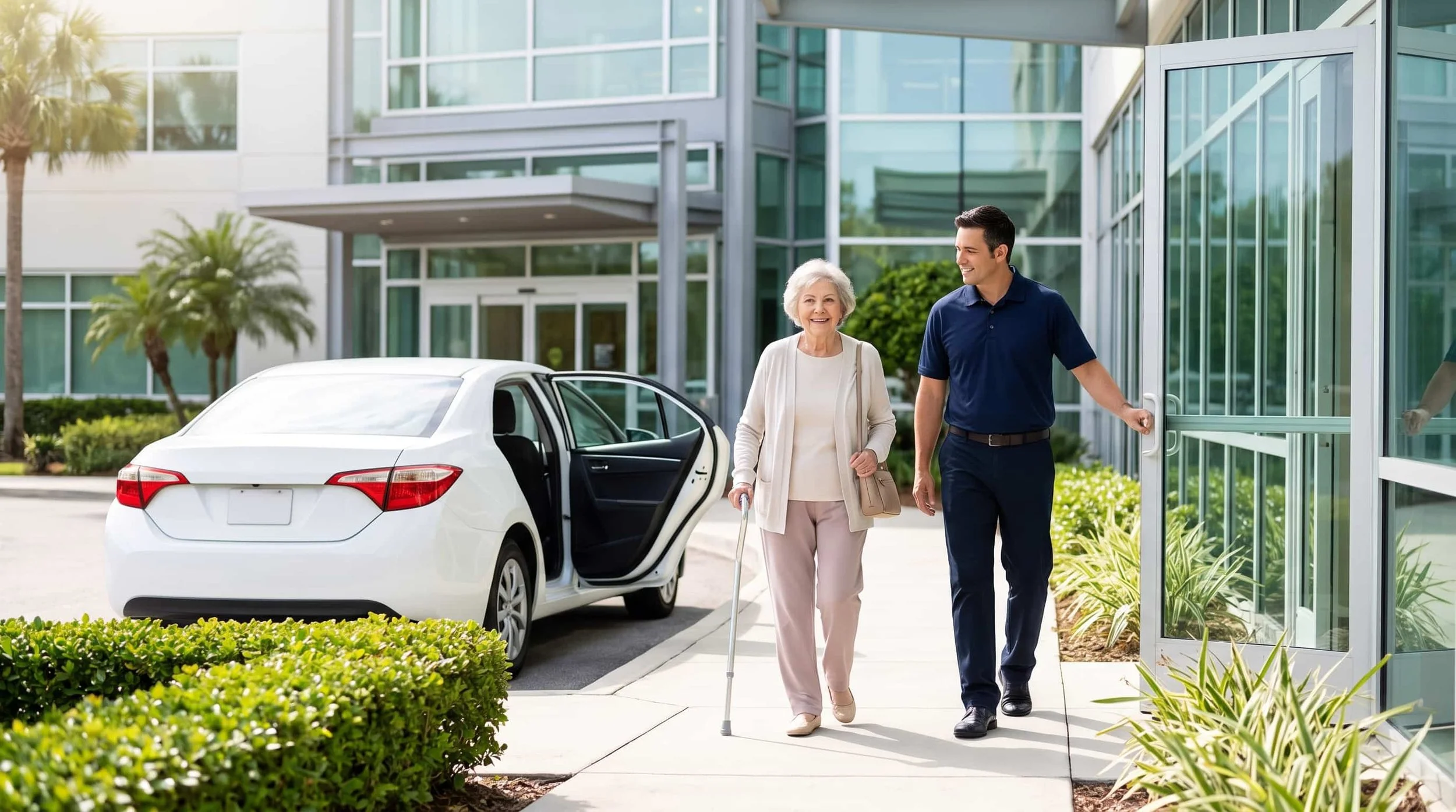
Ambulatory transportation is a medical ride for someone who can walk and sit in a regular seat, with a driver who helps from the door.
No wheelchair, no gurney, no lift. The rider walks, maybe with a cane or a steadying arm, and the help comes in the form of a driver who waits, escorts, and comes back. That last part is what separates it from a taxi.
The people who need it most are often the ones who look like they need it least. Someone who walks across a room without trouble can still be unsafe behind the wheel, or unable to find the right building on a large medical campus.
What Does "Ambulatory" Mean on a Transportation Booking?
It means the rider can get in and out of a standard vehicle on their own two feet. A cane or a walker is usually fine. The booking term describes how the person boards, not how healthy they are.
Dispatchers ask about it first because it decides the vehicle. An ambulatory rider goes in a sedan, minivan, or SUV, in a normal seat with a normal seat belt. A rider who stays in a wheelchair needs a van with a ramp and floor anchors instead.
Getting this wrong at booking is a common cause of a failed trip. A van arrives, the rider cannot board it the way the dispatcher expected, and the appointment is gone. If a parent uses a walker some days and a wheelchair on others, say so when the ride is booked.
How Is an Ambulatory Ride Different From Wheelchair Transport?
The vehicle, the training, and the time on site are all different. An ambulatory trip needs no lift and no securement, so it is the simplest and usually the least expensive level of non-emergency medical transportation.
Wheelchair transport adds equipment and procedure. The chair is loaded by ramp or lift and then strapped to the vehicle floor, and the rider is belted separately. That takes longer at both ends of the trip, and it requires a driver trained to do it correctly. We cover riding in a regular car versus a wheelchair accessible vehicle in more detail, including when a folding chair can travel in the trunk.
The table below is a quick way to match the rider to the right level. The right answer is the lowest level that is still safe, since each step up adds equipment, time, and cost without adding anything the rider needs.
| Ride level | Who it fits |
|---|---|
| Ambulatory | Walks and sits in a normal seat, with or without a cane or walker |
| Wheelchair | Stays seated in a manual or power chair for the whole trip |
| Gurney or litter | Must stay lying down, often after surgery or during a facility transfer |
| Ambulance | Needs monitoring or medical care on the way |
Is an Ambulatory Ride the Same Thing as NEMT?
In everyday industry use, yes. In Medi-Cal paperwork, often no, and the difference matters when someone else is paying for the trip.
The California Department of Health Care Services splits the benefit in two. Non-medical transportation, or NMT, is a ride by private or public vehicle for a member who has no other way to reach an appointment. Non-emergency medical transportation, or NEMT, is an ambulance, wheelchair van, or litter van for a member who cannot use a private or public vehicle at all.
Read that split carefully and most ambulatory riders land under NMT. The same page notes that NEMT requires a prescription from a licensed provider, while NMT does not, which is usually the faster route for a rider who simply needs a seat and an escort. Our plain-language guide to NEMT covers the broader category and the trips it includes.
Why Not Just Use a Taxi or a Rideshare App?
Because the hard parts of a medical trip happen outside the car. A rideshare driver is paid to move a passenger between two addresses, and nothing in that arrangement covers waiting, escorting, or coming back.
What the Driver Is Actually Responsible For
On a medical ride, the driver is expected to arrive at a set time, help the rider from the door, stay or return on schedule, and get the rider back inside at home. Rideshare drivers are not trained for that work and are not dispatched with it in mind. If a rider needs an arm to lean on or a person to find the right suite number, a stranger with an app is a gamble.
What Happens When the Appointment Runs Long
This is where app-based rides fail most often. A medical visit that runs an hour over leaves the rider standing outside with a phone, trying to summon a car in an area where few drivers are waiting. A scheduled return trip removes that problem entirely.
Riders feel the gap between the two systems. A 2026 study of 78 interviews with patients and staff across four Northern California dialysis clinics described exactly this: people navigating health care and transportation at the same time, with the strain showing up as missed and delayed treatment (It's Part of Dialysis: Lived Experiences of Transportation Challenges Among Patients and Staff in In-Center Hemodialysis).
How Much Help Comes With an Ambulatory Ride?
That depends on the service level you book, and the names are worth learning before the trip. Curb to curb, door to door, and door through door are three different things, and only one of them puts a person beside the rider all the way to the exam room.
For a rider with memory loss or poor balance, the level is the whole decision. Our breakdown of curb to curb, door to door, and door through door sets out what each one includes and who it fits.
Ask one direct question when booking: will the driver walk my mother to the front desk, or stop at the entrance? The answer tells you more about the trip than the vehicle type does. MediZoom Transportation offers door-through-door help on ambulatory rides, and one companion can ride along at no extra charge.
Who Pays for an Ambulatory Ride?
Three sources, in rough order of how often they apply: Medi-Cal, a Medicare Advantage plan, or the rider directly. Original Medicare generally does not cover a routine ride to an appointment.
Medi-Cal in Ventura County
Local Medi-Cal members go through their health plan. Gold Coast Health Plan, the Medi-Cal plan for Ventura County, lists one-way and round trip rides at no cost to members on its Transportation Benefits page, with NMT for members who can travel in a regular car and NEMT for those who need a wheelchair van or ambulance and have written approval from a provider. Rides are booked through the plan's transportation line, and the plan asks for at least two business days of notice.
Medicare Advantage
Some Medicare Advantage plans include rides, and fewer do each year. According to KFF (2026), 22% of enrollees in individual Medicare Advantage plans are in a plan that offers a transportation benefit in 2026, down from 28% in 2025, while 73% of Special Needs Plan enrollees have one (Medicare Advantage in 2026: Premiums, Out-of-Pocket Limits, Supplemental Benefits, and Prior Authorization). Call the number on the back of the card and ask how many one-way trips the plan allows per year.
Paying Privately
Private pay is common, and the price is built from the trip rather than from a diagnosis. Distance, time of day, wait time, stairs, and the level of help all move the number, which is why quotes are given per trip. We walk through what affects the cost of medical transportation so the quote makes sense before you book.
Who Actually Needs This Kind of Ride?
People who walk fine and should not be driving, mostly. That group is large and growing. According to the CDC (2026), almost 52 million licensed drivers aged 65 and older were in the United States in 2022, a 77% increase since 2004, and drivers aged 70 and over have higher crash death rates per 1,000 crashes than middle-aged drivers (Older Adult Drivers).
Giving up the keys is only half the problem. The other half is what replaces them, and an unmet transportation need has measurable consequences. A National Health Interview Survey analysis published in 2025 found that among adults aged 65 and older, a transportation barrier to care was associated with higher odds of emergency department use, with an odds ratio of 1.34 (Transportation barriers, emergency department use, and mortality risk among us adults: a national health interview survey analysis).
Common Reasons Someone Stops Driving
Common reasons an ambulatory rider stops driving:
Vision changes, including glare and night driving trouble
Dizziness or balance problems
Medicines that cause drowsiness or slow reactions
Early memory loss, where the route becomes the problem rather than the car
Recovery after surgery, when turning or braking is painful
A procedure requiring sedation, where driving home is not allowed
Families often hit this question during a hard conversation rather than a planned one. Our piece on transportation for medical appointments when a parent stops driving covers how to arrange rides without making the loss of the car the center of every week.
What Should You Have Ready When You Book?
Six details, and having them on hand turns a ten-minute call into a three-minute one. Dispatchers ask the same questions every time because each answer changes the vehicle or the timing.
The appointment date, time, and full address, including the suite or building
The pickup address, plus notes on stairs, gates, or a long driveway
Whether the rider walks unaided, uses a cane or walker, or needs an arm
Whether a companion is coming
Whether the return trip time is known or open-ended
Any oxygen, equipment, or paperwork traveling with the rider
Standing appointments are worth setting up as recurring trips. A rider who goes to physical therapy twice a week does not need to call twice a week, and the same driver tends to show up, which matters more than families expect on a bad morning.
Frequently Asked Questions
Can an ambulatory rider bring a walker or a folding wheelchair along?
Usually yes, and it should be mentioned when booking. A folding walker or a collapsible chair normally travels in the trunk or cargo area while the rider sits in a regular seat. Say what the equipment is, since a power chair cannot be handled that way.
How far ahead should an ambulatory ride be booked?
For a routine appointment, two or three business days is a comfortable window, and insurance-funded rides often require about that much notice. Same-day trips are sometimes possible, though morning slots fill first because so many appointments start early.
Can the driver take the rider somewhere else afterward, like a pharmacy stop?
Often yes, if it is arranged in advance rather than requested from the back seat. An added stop changes the time and the quote, so it belongs in the booking. Insurance-funded trips are usually limited to covered destinations.
What happens if nobody answers the door at pickup?
Drivers follow a set waiting and contact procedure, then notify dispatch, which calls the family or facility. Leaving a second phone number at booking prevents most of these situations. Tell the service in advance if the rider will not hear a knock.
Does the rider need a doctor's note for an ambulatory trip?
Not for a private-pay ride. For an insurance-funded trip it depends on the benefit, and in Medi-Cal a prescription is tied to the NEMT category rather than the simpler non-medical ride. Ask the health plan which form, if any, applies.
Can two people share one ambulatory ride?
A companion normally rides along, and some services include one at no extra cost. Two separate riders going to two different appointments are two trips. A spouse heading to the same clinic usually travels together without a second booking.
Sources Used
It's Part of Dialysis: Lived Experiences of Transportation Challenges Among Patients and Staff in In-Center Hemodialysis – PubMed Central, National Library of Medicine (2026)
Medicare Advantage in 2026: Premiums, Out-of-Pocket Limits, Supplemental Benefits, and Prior Authorization – KFF (2026)
Older Adult Drivers – Centers for Disease Control and Prevention (2026)
MEDI-CAL SUPPORTED NON-EMERGENCY TRANSPORTATION (GOLD COAST HEALTH PLAN) – 211 Ventura County
Transportation Services – Partnership Healthplan of California
Transportation barriers, emergency department use, and mortality risk among us adults: a national health interview survey analysis – PubMed Central, National Library of Medicine (2025)
Is Non-Emergency Medical Transport Safe? A Family Guide – H&M Transport (2023)
