
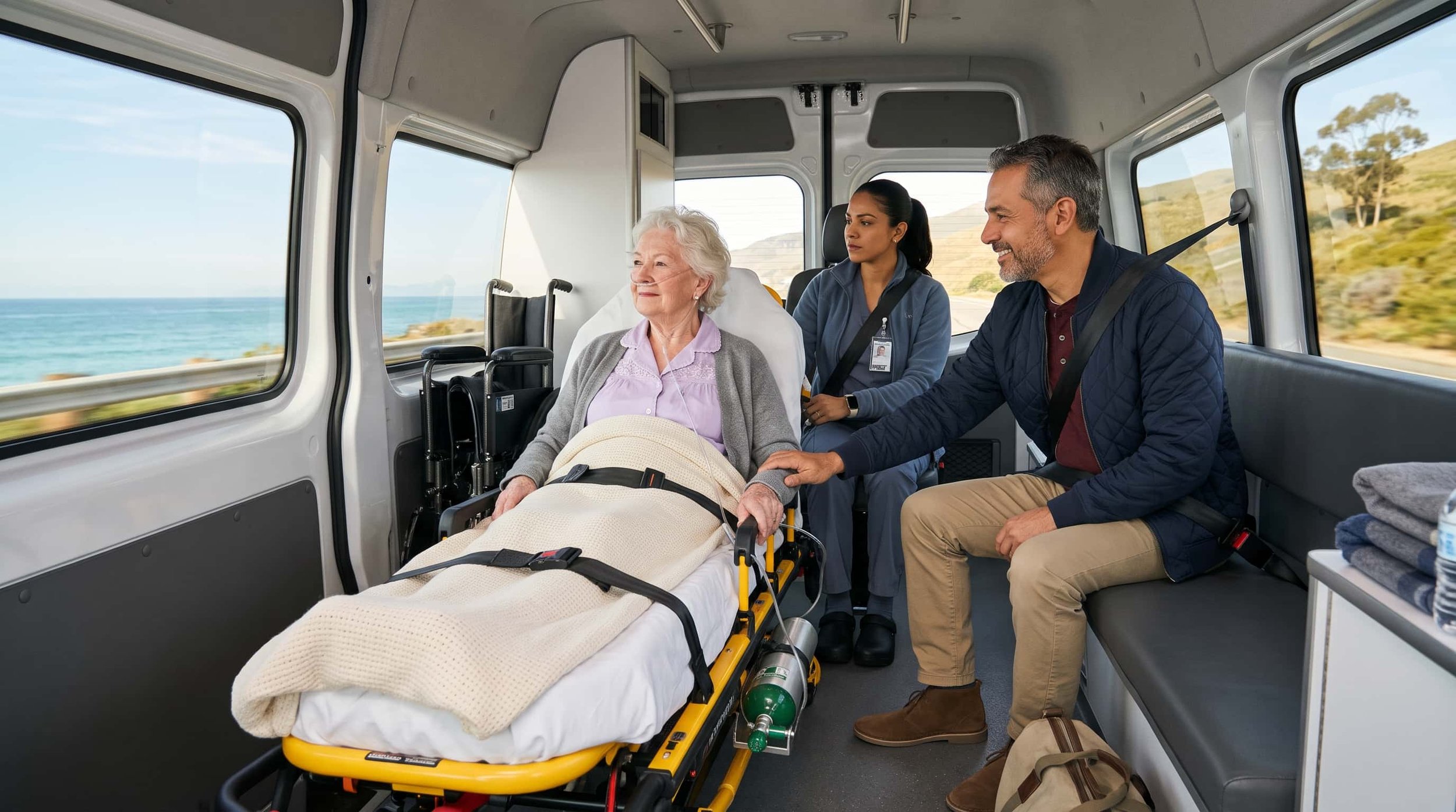
Long distance medical transport moves a patient hundreds of miles by road, bed to bed. For most planned transfers, ground travel is the practical choice.
Air transport wins on speed and little else. A road trip usually costs less, carries the equipment the rider already uses, lets a family member travel along, and avoids the oxygen rules that make flying difficult. Distance and medical stability decide which one fits.
What Is Long-Distance Medical Transport?
It is a scheduled, non-emergency ride over a long distance, with a crew trained to handle the rider rather than just the vehicle. Nobody is in crisis. The need is a safe way to cover the miles.
The trip usually starts at a bed and ends at a bed. Crews help with the move from the room to the vehicle, secure the rider, and hand over at the other end. Common reasons families book one:
Moving a parent to a facility closer to the family
A hospital transfer to a specialist center in another city or state
Discharge from a hospital far from home after an illness on a trip
A move from a care home to a new one across the state
Travel to a long treatment course a rider cannot drive themselves to
The vehicle is matched to the rider, not to the mileage. Someone who can sit upright travels in an ambulatory seat or a wheelchair van. Someone who must stay flat travels on a gurney. The service level matters as much as the vehicle, and the difference between curb to curb, door to door and door through door shows up more on a long trip than on a short one.
When Does Ground Travel Make More Sense Than a Flight?
When the trip is planned and the rider is stable. Air transport exists for speed, and speed is worth paying for when hours change an outcome. A planned move does not usually turn on hours.
The Trip Is Planned Rather Than Urgent
A scheduled transfer can be built around rest stops, meals and a comfortable departure time. A rider leaves from their own room, stays in one vehicle, and arrives at a room at the other end. Nothing gets loaded and unloaded between a van, a terminal, an aircraft and a second van.
The Rider Uses Oxygen or Carries Equipment
This is where flying gets complicated fast. FAA (2026) states that passengers may not carry their own compressed or liquid oxygen in checked baggage, carry-on baggage or on their person, and that oxygen used in the cabin must be supplied by the airline. The same FAA guidance adds that airlines are not required to offer that service and many do not.
The gaps around the flight matter too. MedlinePlus (2026) advises telling the airline two weeks ahead, notes that an airline may not be able to help with less than 48 hours' notice, and points out that airlines and airports will not provide oxygen outside the aircraft, including before the flight, after it and during a layover. A road trip carries the oxygen the whole way without a single handoff.
Family Wants to Travel With the Rider
On a ground trip a companion usually rides in the same vehicle at no extra fare. On a flight, seats are limited and a second ticket costs what a second ticket costs. For a rider with memory loss, having a familiar face in view for the whole trip is not a small detail.
The table below lines up the two options on the points families actually weigh. Treat it as an orientation rather than a rule, because a rider who is unstable belongs in whichever vehicle the medical team says, regardless of cost or comfort.
| What to compare | Ground medical transport | Air medical transport |
|---|---|---|
| Typical use | Planned transfers, moves closer to family, hospital to rehab | Urgent transfers, very long distances, unstable riders |
| Travel time | Hours to a couple of days, with scheduled stops | Hours in the air, plus ground legs at both ends |
| Oxygen | Carried on board and used throughout the trip | Supplied by the carrier; personal cylinders are not allowed |
| Lying flat | Possible for the entire trip on a gurney | Depends on the aircraft and the seating |
| Family along | A companion can usually travel in the same vehicle | Limited seats, usually at extra cost |
| Handoffs | One vehicle, bed to bed | Transfers between vehicle and aircraft at both ends |
How Do You Transport a Parent Who Cannot Sit Up?
On a gurney, in a vehicle built to carry one. The rider stays flat, secured, with the head slightly raised if that is more comfortable. A crew member stays in the back rather than up front.
Stops and Position Changes on the Road
Position changes are part of the plan on a long trip. MedlinePlus (2025) notes that changing a person's position in bed every two hours helps keep blood flowing, which protects the skin and prevents bedsores. The same thinking applies on the road, so a long route is built with stops rather than driven straight through.
What the Dispatcher Needs to Know
Tell the dispatcher what the move at each end looks like. Stairs, a narrow hallway, a doorway that a gurney cannot turn in, a second-floor bedroom with no elevator: these decide how many crew members come and how long the pickup takes. A surprise at the door costs more time than the drive does.
If the trip starts at a hospital, the discharge planner is the person to loop in early. The same coordination that makes a hospital-to-rehab or hospital-to-home transfer go smoothly matters more when the destination is eight hours away instead of twenty minutes.
Can Someone Recovering From a Stroke Handle a Long Day on the Road?
Often yes, with the right vehicle and a realistic schedule. The question is not the distance but whether the rider is stable, and that answer belongs to the treating team rather than to the transport company.
Bring the question to the doctor plainly: can this person travel by road for this many hours, with stops. Ask what to watch for along the way, whether swallowing or positioning needs attention, and what should trigger a stop at a hospital instead of the next rest area. Get it in writing if the receiving facility will want it.
Then build the trip around the answer. Shorter driving days, more stops, and a departure time that matches when the rider is at their best all help. Splitting a very long route across two days is routine, not a failure of planning.
Who Rides Along on a Long Medical Trip?
A trained crew, and usually a family member. The crew level depends on what the rider needs: an attendant for help and monitoring, or clinical staff when equipment and assessments are part of the trip. A medical escort is the version of this that travels with a rider on a commercial flight.
On very long routes, driver fatigue is the real risk rather than the mileage. FMCSA (2026) sets maximum on-duty and driving time for commercial drivers and requires a break of at least 30 consecutive minutes after eight cumulative hours of driving, specifically so drivers stay awake and alert. Serious operators plan around limits like these instead of pushing one person through.
That is why two-driver teams work the way they do on long medical trips: one drives while the other rests, and someone is always free to watch the rider. MediZoom Transportation staffs long routes this way across Ventura County and beyond, and one companion rides along at no extra charge.
What Does Long-Distance Medical Transport Cost, and Does Medicare Pay?
Ground trips are normally priced as a base rate plus a loaded mileage rate, with the vehicle type driving the base. A gurney trip with clinical staff costs more than an ambulatory seat for the same miles. Ask for the quote as a written total for the specific route rather than a per-mile figure.
What Insurance Does and Does Not Cover
Coverage is the part that disappoints families. Original Medicare pays for ambulance transport under narrow medical-necessity rules and does not work as a general ride benefit, which is covered in detail in what Medicare does and does not cover for non-emergency transportation. Medicaid programs do have a transportation benefit, though rules on long-distance trips vary by state and plan, so the member services line on the card is the only reliable answer.
Billing surprises are also a state-by-state matter. CMS (2026) lists ten states that have their own protections against surprise bills for ground ambulance services, which means the rest leave it to the provider and the plan. That is a reason to settle the price in advance on a planned trip, and the same factors that move the cost of a medical transportation ride apply over 600 miles just as they do over six.
What to Confirm Before Comparing Quotes
Ask what is included before you compare two quotes. Waiting time at either end, a second attendant, overnight costs on a multi-day route, tolls and the return of an empty vehicle can all sit inside or outside the headline number.
How Far Ahead Should You Book a Long-Distance Trip?
As soon as the destination is settled, and at least several days out when you can. Long routes need crew scheduling, vehicle assignment and sometimes an overnight plan, so the earliest call gets the best departure time.
Have these ready when you call, and the quote comes back faster:
Pickup and drop-off addresses, including the room or unit at each end
Whether the rider can sit upright, uses a wheelchair, or must stay flat
Weight, height and any equipment traveling along, including oxygen
Stairs, elevators, narrow doorways or gates at either address
Who is traveling as a companion, and who to call during the trip
The date the receiving facility can accept the arrival
One call settles most of it. The team at MediZoom Transportation can price a long route, say which vehicle fits, and tell you honestly when a flight would serve the rider better than a road trip.
Frequently Asked Questions
Does the trip stop overnight on a very long route?
On multi-day routes, yes. The vehicle stops at a hotel, the rider rests, and the trip continues in the morning. Ask how the overnight is handled and whether it changes the price.
Can the rider bring both a wheelchair and a walker?
Usually both travel in the vehicle at no extra cost. Mention them when booking so the crew allows for the space, especially on a gurney trip where the floor area is already committed.
What happens if the rider's condition changes on the road?
The crew stops and calls for emergency care at the nearest hospital rather than continuing. Make sure the dispatcher has a family phone number that will be answered for the whole trip.
Do crews cross state lines?
Long-distance operators plan interstate routes regularly. Licensing and vehicle rules differ by state, so ask whether the company runs the whole route itself or hands the rider to a partner partway.
Is a doctor's order needed to book a non-emergency trip?
Not usually for a private-pay ride. An order or a note may be required by the receiving facility, or by a plan that is paying, so check both before the departure date.
Can medicines be given during the ride?
That depends on the crew level and state scope-of-practice rules. Many trips travel with a family member or escort who handles this, so ask when you book rather than on the day.
Sources Used
Action plan: Ground ambulance bill – Centers for Medicare & Medicaid Services (2026)
Hours of Service (HOS) – Federal Motor Carrier Safety Administration (2026)
PackSafe - Oxygen (compressed or liquid) – Federal Aviation Administration (2026)
Traveling with breathing problems – MedlinePlus, National Library of Medicine (2026)
Turning patients over in bed – MedlinePlus, National Library of Medicine (2025)
When a Family Road Trip Isn't Possible: Arranging Private Long-Distance Medical Transport for Elderly Parents – MedicalRide (2026)
