
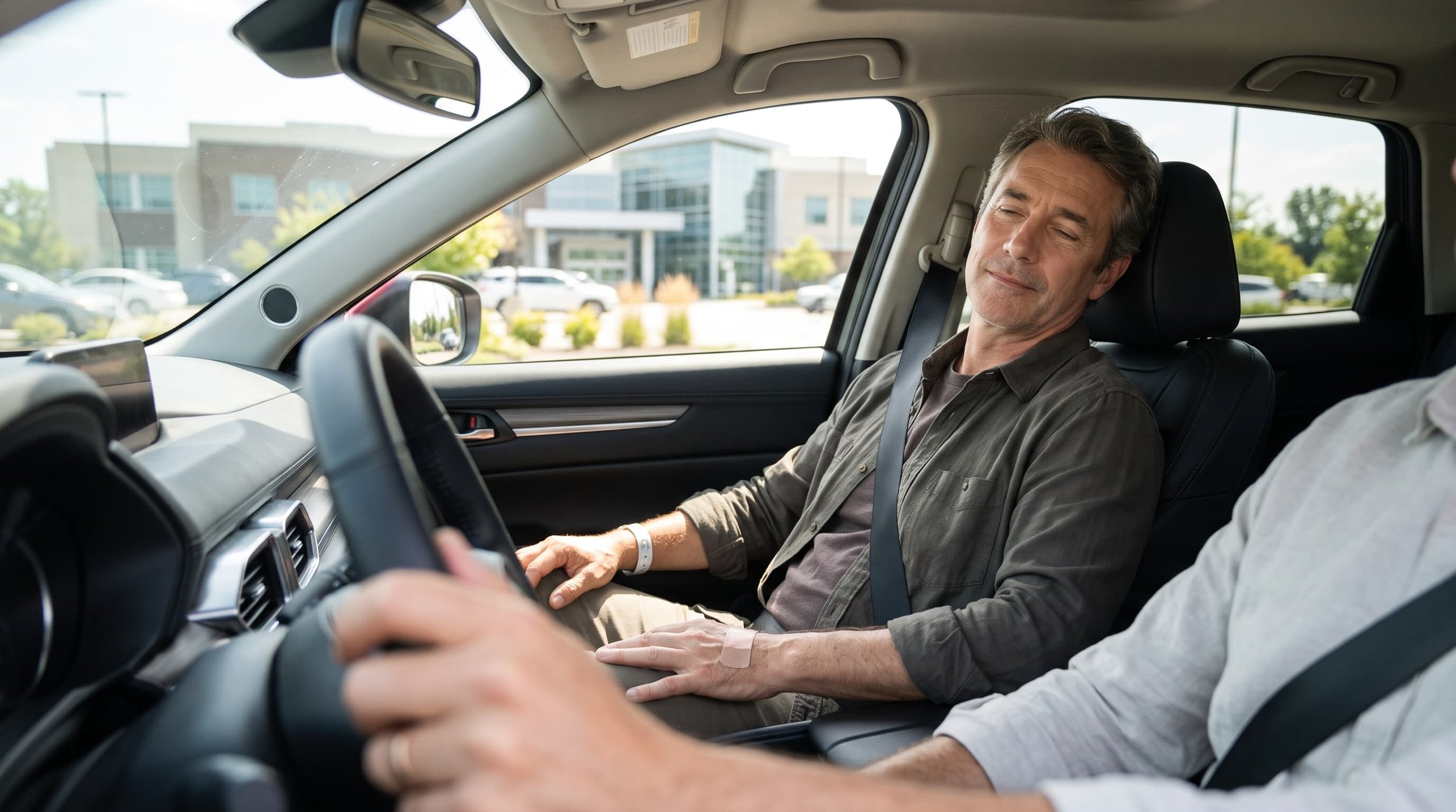
You cannot. Plan on no driving for at least 24 hours after surgery, and on someone else taking you home from the clinic that day.
So how long after anesthesia can you drive? The baseline comes from MedlinePlus (2026), whose day-of-surgery instructions tell adults not to drive for at least 24 hours after their surgery, and to ask the surgeon about driving if they are taking medicine afterward. The ride home is a separate problem from the 24 hours, and it is the one that catches people out the morning of the procedure.
Why You Really Cannot Drive Yourself Home After Anesthesia
Because the drug is still working on your brain long after you feel awake. Cleveland Clinic (2026) says it tends to take one to two hours for general anesthesia to wear off, and describes the wake-up itself as groggy and disoriented, with temporary memory loss built into how the medicine is designed to work.
Feeling fine is not evidence that you are fine. Judgment, reaction time and attention come back more slowly than the ability to hold a conversation, which is exactly the combination that makes a patient confident enough to ask for their keys. Nobody in the recovery room can measure that for you at the door.
There is a plainer reason too. MedlinePlus (2025) lists the usual aftermath of general anesthesia as tiredness, grogginess, nausea, dry mouth, sore throat, chills and restlessness, and says these typically fade over a few hours. Any one of them is a poor companion on a freeway on-ramp.
How Long After Anesthesia Can You Drive?
Twenty-four hours is the standard floor, and for some operations it is weeks. The 24-hour figure is about the drug clearing; the longer timelines are about the body part that was operated on.
The First One to Two Hours
This is the window the Cleveland Clinic guidance above describes for general anesthesia to wear off. You will likely be in a recovery area for part of it, and someone will check your breathing, your pain and whether you can keep fluids down before you are discharged.
The Rest of the First Day
Driving stays off the list for the whole day. Cleveland Clinic (2026) advises avoiding driving or operating equipment for 24 hours, having someone drive you home, resting for the remainder of the day, skipping alcohol, and holding off on important or legal decisions for the same 24 hours. That last item is a useful signal of how much the medicine affects thinking, not just coordination.
The same source notes that most anesthesia side effects are temporary and gone within 24 hours, often sooner, but that confusion or delirium can last several days in people over 65. For an older patient, the first day is not automatically the end of it, and a family member is better placed to notice that than the patient is.
When It Is Weeks, Not Hours
For many operations the limit has nothing to do with anesthesia. Vision, a braced knee, a healing incision or pain medicine can each push the date out, and the person who sets it is the surgeon. MedlinePlus (2024) puts When will I be able to drive? on its list of questions to ask before cataract surgery rather than answering it, which is a fair reflection of how much it varies between patients.
Joint surgery works the same way. The MedlinePlus discharge instructions for a knee joint replacement (2024) cover walking aids, activity limits and warning signs, and leave the driving date to the surgical team. Asking at the pre-op visit, in writing, saves a phone call later in the week when nobody is available.
The table below sets the two clocks side by side. The first is the drug; the second is the operation.
| Time after anesthesia | What is usually true |
|---|---|
| First 1 to 2 hours | General anesthesia typically wears off; grogginess and disorientation are expected |
| Rest of the day | No driving, no machinery, no alcohol, no major decisions |
| Within 24 hours | Most side effects have faded, often sooner than that |
| Several days, age 65 and over | Confusion or delirium can persist; worth watching for |
| Days to weeks, depending on the operation | The surgeon sets the driving date for eyes, joints and incisions |
Can You Take an Uber or Taxi Home Alone After Sedation?
A rideshare solves the driving problem and leaves the supervision problem untouched. The patient guidance above does not say get a ride, it says have someone drive you home, and the difference matters when you are unsteady on a curb or cannot remember which door is yours.
Think about what the trip actually asks of you. You have to find the car, get into it unaided, stay oriented, give the right address, get out, manage a path or a flight of stairs, and let yourself in. A driver who is not allowed to leave the vehicle cannot help with any of that, and will not notice if you are becoming confused.
This is the gap non-emergency medical transportation fills. A ride with door-through-door help means an attendant walks you from the clinic to the vehicle and from the vehicle into your home, and the service levels differ in ways worth understanding before you book one, which this piece on curb to curb, door to door and door through door sets out. For a wheelchair user or anyone leaving a procedure unsteady, that is the practical answer.
Will the Clinic Let You Leave Without Someone With You?
That is set by the facility, not by a national rule, so ask yours directly. What is consistent across patient guidance is the instruction itself: have someone drive you home after, as the Cleveland Clinic preparation advice puts it.
Many surgery centers build their discharge process around that instruction and will want a name and a phone number in advance. Some ask for a responsible adult who can be reached during the procedure. Others will accept a booked medical transport with an attendant. Because the answer varies, the question belongs at the pre-op appointment, not at the discharge desk.
If the honest answer is that nobody is available, say so early. A surgery center can usually work with a booked transport arranged in advance, and a cancelled procedure on the day costs everyone more than a phone call a week earlier.
Does Someone Need to Stay With You at Home Afterward?
For the first night it is a sensible assumption, and for an older patient it matters more. The Cleveland Clinic guidance asks you to rest for the remainder of the day and holds off driving, alcohol and significant decisions for 24 hours, and the same source notes confusion or delirium lasting several days in people over 65.
The practical jobs are small and hard to do alone: getting to the bathroom safely, keeping fluids down, following instructions about dressing, and knowing who to call if something looks wrong. Most of them are a problem only once, and only if nobody is there.
If the family lives far away, the overnight is the part to solve first, before the ride. Neighbors, a short paid shift, or a relative arriving the evening before all work. The ride itself is the easier half to arrange.
How to Arrange the Ride Before Your Surgery Date
Book it when the surgery is booked, not the night before. Discharge times move, and a ride that has to be found at short notice is the one that goes wrong.
Five details make the booking straightforward: the clinic name and address, the earliest likely discharge time, whether you will be walking, using a wheelchair or on a gurney, how many steps there are at home, and whether someone will be with you. A transport service plans the vehicle and the staffing around those answers.
Hospital discharges have their own quirks, including waits and last-minute changes of destination, and this explainer on hospital-to-rehab and hospital-to-home transfers covers what usually goes sideways. If the surgery is part of a wider pattern of someone no longer driving, the groundwork is in this piece on transportation for medical appointments.
Bookings can be made ahead through MediZoom Transportation, whose office hours run 8 AM to 6 PM, five days a week. Put the return trip in the calendar the same day you put in the surgery.
Frequently Asked Questions
Does local anesthesia come with the same driving restriction?
Recovery from local anesthesia takes less time than from sedation, regional or general anesthesia, so the restrictions are usually lighter. Confirm with the person who performed the procedure, since the medicine used is not always what the patient assumes.
What if my procedure is at the end of the day and I feel fine by evening?
Feeling fine arrives before the drug has finished clearing. The 24-hour clock starts at the surgery, not at the moment you stop feeling groggy.
Can my insurance pay for the ride home?
Some plans cover non-emergency medical transportation and many do not, and the rules differ between Medicare, Medicare Advantage and Medicaid programs. Ask the plan directly and get the answer before the day of the procedure.
Is a gurney ride necessary, or is a wheelchair enough?
It depends on whether you can sit upright for the length of the trip and transfer in and out of a seat. The discharge nurse can usually tell you which one your condition calls for.
What should I bring with me for the trip home?
Loose clothing, your discharge paperwork, a phone that is charged, and a list of who to call. Leave jewelry and anything valuable at home, and leave the car keys there too.
Can the same ride take me to the follow-up visit a week later?
Yes, and booking both at once is usually simpler. Follow-up appointments after eye or joint surgery often land inside the window when driving is still off the table.
Sources Used
Anesthesia – Cleveland Clinic (2026)
Cataracts - what to ask your doctor – MedlinePlus, U.S. National Library of Medicine (2024)
General anesthesia – MedlinePlus, U.S. National Library of Medicine (2025)
General Anesthesia – Cleveland Clinic (2026)
Knee joint replacement - discharge – MedlinePlus, U.S. National Library of Medicine (2024)
The day of your surgery - adult – MedlinePlus, U.S. National Library of Medicine (2026)
Advice following a general anaesthetic – Wirral University Hospital NHS Foundation Trust
